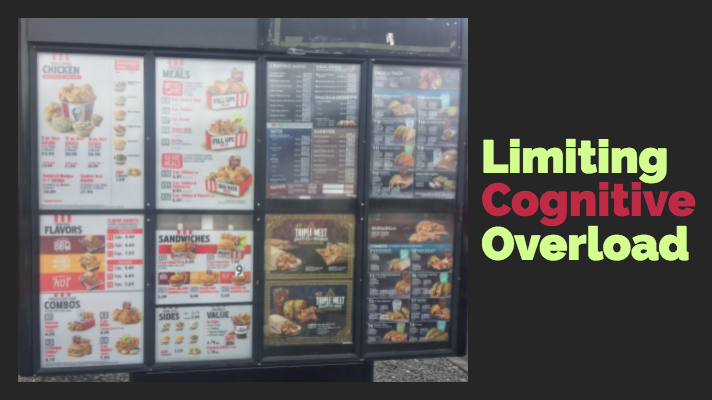
The other day my kids sent me to KFC to pick up something, we were pressed for time, it was close, fast, and ehh I didn’t mind.
Until of course I got to KFC. It had been years since I’d been to KFC and I have to say I was quickly taught a hands-on lesson in cognitive overload from their menu.
The KFC menu is the manifestation of cognitive overload.

It’s just too much. Too Complicated. Too Overwhelming.
What is Cognitive Overload?
Cognitive Load Theory helps to explain how the cognitive demands of learning can impede a learner’s ability to process new information. It was first outlined in 1988 by John Sweller from the University of New South Wales in Australia. He expanded on the model of working memory to help explain how unnecessarily complex or distractions increase the cognitive load and make it more difficult to pay attention and remember which makes learning more difficult.
There are three types of cognitive load.
The first is Intrinsic Cognitive Load which describes the intrinsic quality of the information being taught. Since this type of load is intrinsic to the subject it is difficult to eliminate. There will always be a load and this is simply the price.
The second type of cognitive load is Extraneous Cognitive Load which as the word extraneous implies is the distracting or unnecessarily complex design of instruction which wastes cognitive energy. For example, some types of information are just easier to understand when done visually or with a model that described in long form text. And for the fans of Dr. Richard Clark he even mentioned that the most efficient and cost-effective mediums should be chosen, he wasn’t strictly speaking of money.
The third type of cognitive load is Germane Cognitive Load. This type of load involves the filing of the learning with the correct schema or the construction of a new schema if the learning were unique enough. It’s important to know that each of us has a limited cognitive capacity and these three types of cognitive load are additive. So the way to maximize germane cognitive load is to reduce extraneous cognitive load and to do what we can with the intrinsic cognitive load.
How to Avoid Cognitive Overload in Instructional Design?
When designing a course, especially if you’re also the subject matter expert, it can be tempting to fill the course with everything. Every bit of knowledge and insight and wisdom you have. Doing so will as we know overload your learner and they will shut down. The saying “Less is More” is quite true.
It is important to properly chunk and break down your learning objectives as much as possible. By focusing on only what is necessary at the time you can reduce the intrinsic cognitive load.
Reducing extraneous cognitive load comes down to using good design, don’t make learners go and look for information. Keep design elements simple and not distracting. Remove unnecessary elements and do what you can to maximize the task analysis to break down the learning into as many parts as possible. A common approach to reducing extraneous cognitive load is the “worked example” where each of those steps is demonstrated one at a time so learners are better prepared to try on their own.
There are ways to maximize germane cognitive load as well. This comes down to helping students access the relevant schemas they may have by explaining how the lesson integrates with their background knowledge and any previous understand that relates to the topic. Also by showing where the new information will be valuable can also prime them to access information in that category of their memory.
Practical Design Tips?
- Reduce distraction,
- Simplify instructional materials,
- Use good UX design principles
- Scaffold & chunk information
- Help place the learning in context for the learners.
- And use worked examples where possible.
There is a lot more to Cognitive Load Theory and my favorite book is probably a bit overkill for most people but it’s:
Sweller, J., Ayres, P., & Kalyuga, S. (2011). Cognitive Load Theory (2011 edition). New York: Springer. https://amzn.to/2HKzIQh (that’s an affiliate link which helps add some pennies to the book buying fund if you do use it but doesn’t cost you any extra).
 Christopher Bergeron
Leave a comment